4 Tips For Improving Mental Health in the Workplace in 2024

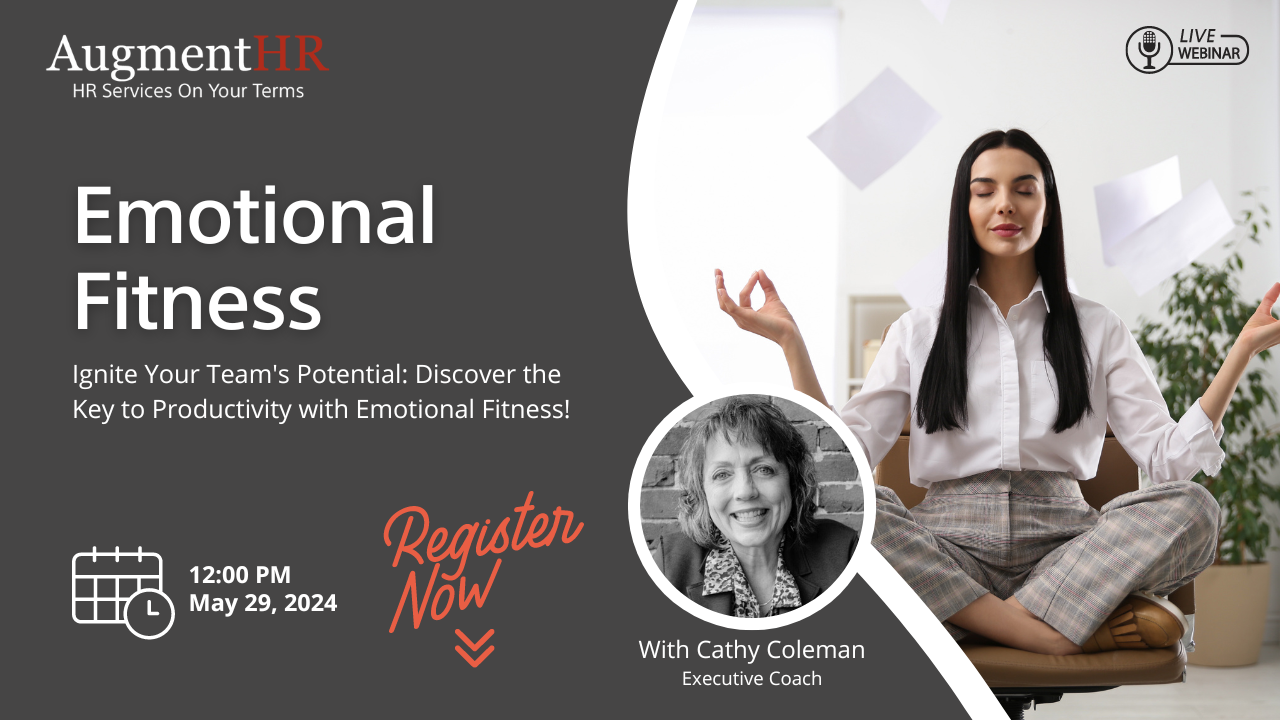
One of the most challenging things to deal with as an employer is Mental Health in the workplace. The reason for this is the stigma attached to those words. Yet Mental Health - or Emotional Fitness as we call it - is key to unlocking your company’s peak performance and increasingly so. In this blog post I’ll share some excerpts from my upcoming AugmentHR webinar: ‘Emotional Fitness: Ignite Your Team’s Potential: Discover the Key to Productivity with Emotional Fitness’ (see below for your invite). In this post we’ll answer some common questions;
- Why is mental health in the workplace important?
- What is mental health in the workplace? Vs Mental Illness Vs Emotional Fitness
- What affects mental health in the workplace?
- And most importantly, how do you deal with mental health in the workplace? What is the employer’s role?
Why is mental health in the workplace important?
Why should an employer worry about mental health in their workplace?
- 1 in 5 people in Canada will experience challenges with their mental health at some time throughout the year and out of that, 1 in 3 will take time off from work.
- In the last five years, 38% have taken time off because of mental health.
- The average length of absence is 12 days.
- Annually the Canadian economy loses $50 billion on absenteeism and disability while employers lose $17 billion on the cost to business of lost productivity and,
- Younger workers experience it to an even greater degree.
And, beyond absenteeism, companies who have low emotional fitness in the workplace experience the following:
- Decreased Productivity:
Poor mental health within a company leads to a lack of focus, procrastination, no energy, tasks take longer to complete. - Poor Decision-Making:
Exhausted and emotionally drained, those suffering from low emotional fitness can’t think clearly, leading to errors and set-back of deliverables. - Increased conflict:
Friction and tension will always increase the more challenged someone is. - High turnover:
Burnout and emotional upheaval lead to a loss of talent and a disruption to the team resulting in increased employee costs.
On the other hand, companies that work to strengthen their employee’s emotional fitness:
- Contribute to a positive work culture,
- Foster employee engagement & loyalty,
- Build teams that have increased resilience, improved communication, are more creative and embrace change and,
- Improve company productivity and employee satisfaction.
What is mental health in the workplace?
Mental Illness often gets confused with Mental Wellness so let’s start with a few definitions:
Mental Health refers to the general state of one’s psychological and emotional well-being.
Mental Illness is a condition diagnosed by a qualified healthcare professional. The two get intertwined causing confusion and escalating the feelings of isolation when people are feeling challenged.
Emotional Fitness is our term for what we work on for companies as HR consultants. When we think of physical fitness we’re all clear on what it means and what it takes (e.g. healthy diet, regular exercise, good sleep habits etc.). As a society, we’re not as comfortable on what it means to be Emotionally Fit. Like physical fitness, it speaks to the ability to get strong, to improve. For a company that’s Emotionally Fit it’s about:
- Having healthy emotions, beliefs and feelings
- Effective ways of managing stress, anxiety, worry, fear and other everyday negative emotions and,
- Being able to manage and work through problems, challenges and conflict together.
What affects mental health in the workplace?
Canadian HR Reporter recently shared the results of a Canadian study that reported on the main causes of mental health that impact employers. The top results are:
- Finances (48%) and workplace challenges (30%) were the top 2 causes in those ages 18 - 24
- Procrastination – leading to feeling overwhelmed and unmanageable workload
- Mismanaged expectations and disappointments, lack of clarity in role
- Personal issues and life events
- Problems at work with co-workers, leaders and workload
How do you deal with mental health in the workplace? What is your role as an employer?
In the webinar, I share two case studies from my 25 years of experience coaching companies and studying emotional fitness. One is a high-performing marketing team at a tech startup under immense pressure to meet aggressive deadlines. The other is a global logistics company facing a crisis when a key supplier unexpectedly goes out of business.
Some of the lessons learned for improving Emotional Fitness I share include these 4 factors to having an emotionally fit workplace:
- Be proactive in the workplace with support and programs to develop Emotional Fitness strategies and support to deal with stress and build resilience.
- Encourage work/life balance and a culture of leadership that knows how to support their people
- Foster a culture of adaptability and collaboration, where employees feel empowered to innovate and problem-solve in times of crisis.
- Prioritize open and honest communication to build trust and resilience among teams, enabling them to face adversity with confidence and determination.
In the webinar, I teach how being Emotionally Fit can improve the mental health in your workplace to ignite your team's potential. I dive deep into the case studies and share more strategies for employers and some simple everyday tactics you can use.
Grab your spot now.
Cathy Coleman is a senior HR consultant at AugmentHR with 25 years of experience helping companies boost the performance of their people. She is an accomplished Master Facilitator with experience across 4 continents from Switzerland to Singapore. Her mission is to empower companies and individuals with the tools & strategies to achieve success.
More HR Solutions for Improving Employee Relations & Retention