
Workplace Harassment Policy Guide: HR Compliance Checklist
By Jeff Mignault - AugmentHR Consulting
Director, Customer Experience
Workplace harassment is a serious issue. The holidays are considered a dangerous time for harassment to happen because of the heightened stress of this time of year and the increased number of social gatherings and interactions between co-workers.
Two things I’ve learned about workplace harassment in my 15 years working in HR outsourcing management:
One, all organizations - big or small - should have a well-defined and robust workplace harassment policy that clearly outlines employee expectations.
Two, even with good policies in place, incidents still happen and managing harassment complaints is stressful for all parties involved. It could lead to legal issues and negatively affect company culture. Employers are legally obligated to take steps to prevent workplace harassment from happening.
So, with that in mind, we’ll cover on what you need to make sure you’re covered on Workplace Harassment in the least stressful way possible including:
- A definition of workplace harassment
- Examples of workplace harassment - the 4 main types of harassment
- Situations where harassment can happen
- The problem with workplace harassment - many people don’t report it
- What employers are required to do to prevent and deal with harassment
- 7 things employers can do today to minimize harassment
- How to conduct a workplace harassment policy review
What is Workplace Harassment?
Harassment is against the law. Workplace harassment comes in many forms. It is unwanted or inappropriate actions, comments, or gestures that offend others. It can be a single occurrence of ongoing behaviour.
Harassment refers to experiencing unwelcome verbal or physical behaviour that is connected to grounds of discrimination prohibited by law under the Charter of Human Rights and Freedoms.
According to Part II of the
Canada Labour Code:
“any action, conduct or comment, including of a sexual nature, that can reasonably be expected to cause offence, humiliation or other physical or psychological injury or illness to an employee, including any prescribed action, conduct or comment.”
What Are Examples Of Workplace Harassment? 4 Types Of Workplace Harassment
Workplace harassment takes on many forms. The four most common are sexual, racial, psychological and physical harassment. Below are examples of these different types of harassment:
Sexual Harassment
Sexual harassment is any unwelcome behaviour of a sexual nature, including comments, actions, or gestures. Examples include:
- Verbal abuse or threats.
- Unwelcome remarks, jokes, innuendoes or taunting.
- Displaying of pornographic or other offensive or derogatory pictures.
- Practical jokes which cause awkwardness or embarrassment.
- Unwelcome invitations or requests, whether indirect or explicit, or intimidation.
- Leering or other gestures.
- Unnecessary physical contact such as touching, patting, pinching, punching.
- Physical assault.
Racial/Ethnic Harassment
Racial harassment is conduct or comment which causes humiliation to an employee because of their racial or ethnic background. Examples include:
- Unwelcome remarks, jokes, or innuendos about a person’s racial or ethnic origin.
- Colour, place of birth, citizenship, or ancestry.
- Displaying racist or derogatory pictures or other offensive material.
- Insulting gestures or practical jokes based on racial or ethnic grounds
- Treating someone differently because of their ethnic or racial background.
Psychological Harassment
Psychological harassment is repeated and unwelcome conduct, words, actions, or gestures that harm a person's dignity or psychological well-being. Examples include:
- Denial of personal contact (the harasser no longer speaks or looks at the person).
- Denial of working abilities (impossible tasks).
- Punitive techniques.
- Abusive or derogatory name-calling or language.
- Hostile work environment.
Physical Harassment/Workplace Violence
Workplace violence is the exercise, statement, or behaviour of physical force by a person against a worker, in a workplace, that causes or could cause physical injury to the worker. Examples include:
- Physical acts (e.g., hitting, shoving, pushing, kicking, sexual assault, throwing an object at a worker).
- Any threat, behaviour, or action interpreted to carry the potential to harm or endanger the safety of others, result in an act of aggression, or destroy or damage property.
- Disruptive behaviour that is not appropriate to the work environment (e.g., yelling or swearing).
Where Can Workplace Harassment Occur?
Workplace harassment can happen in many locations. It doesn't have to happen physically at your place of work to qualify. Here are common areas where workplace harassment occurs:
- At the workplace (anywhere on company property).
- At employment-related social functions (holiday parties, employee appreciation events).
- Work assignments outside the workplace (client's office/location).
- During work-related travel (conferences and training sessions).
- Over the telephone, if the conversation is work-related.
- During online meetings, conferences or chats (including social media and email).
- Any location where a person is present for work-related responsibilities or a work-related relationship.
The Problem With Workplace Harassment - People Don’t Always Report It
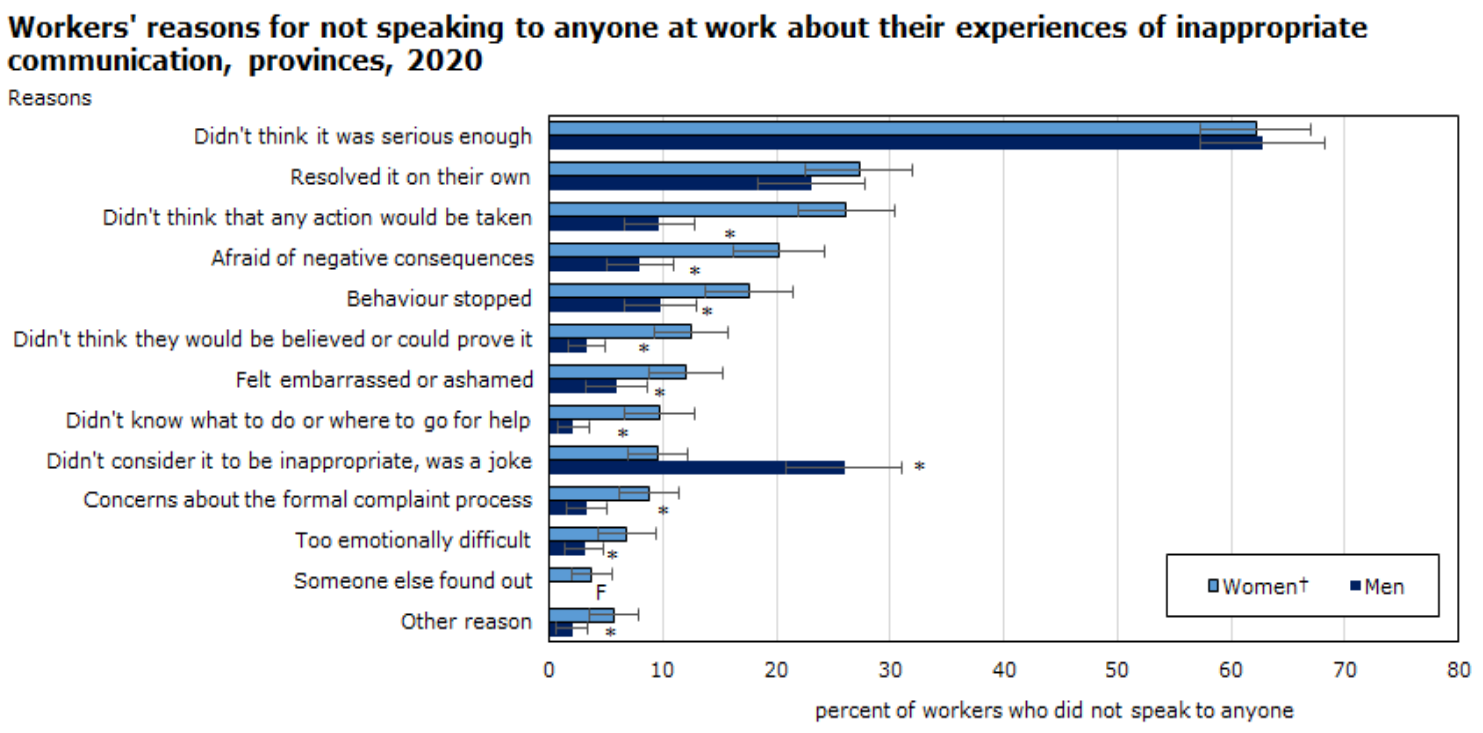
One of the biggest challenges with workplace harassment is many people choose not to speak up when it happens. It's a sensitive subject and many worry about the outcome of reporting it. The graphic here shows too many reasons people choose not to report it:
What Are Employers Required To Do If They See Harassment?
Everyone has a responsibility to help stop harassment at work. Expectations for what you are expected to do depend on your role in the organization:
Employers: Ensure the company and employees comply with all anti-harassment policies and laws.
Manager: Help to protect workers from experiencing harassment from other employees, leaders and anyone causing harassment.
Employer: It’s an employee's duty to report harassment if they are a victim. Employees are also encouraged to report harassment if they witness it in the workplace.
When each person does their duty, organizations can reduce and/or eliminate harassment.
7 Things Employers Can Do Today To Minimize Harassment
- Whether an issue or not, there is a lot employers can do to minimize harassment in their workplace. Remember, a lot of harassment goes unreported. Here are things you can to reduce harassment issues:
- Stress there is zero tolerance for harassment.
- Encourage people to report harassment if they are a victim or see others being harassed.
- Develop written policies (if you don't already have one). Include harassment policies in your handbook.
- Include harassment training in all new employee training materials.
- Have a clear process for people to report harassment. It's particularly important to have procedures for workers to report incidents to someone other than their supervisor or employer if those persons are the alleged harasser.
- Review your anti-harassment program annually. Assess the risk of workplace harassment and communicate the results of the assessment to the joint health and safety committee.
- Ensure all harassment investigations are appropriate to the circumstances; communicate, in writing, the results of a harassment investigation to the worker and alleged harasser (if they’re an employee).

Is Your Harassment Policy Up To Date? Is It Thorough?
When was the last time you did an internal review of your harassment policy? It's important to perform a review annually to ensure all documentation is up to date with current laws.
Review your workplace violence and harassment policies to make sure that they address the following points:
- The definition of workplace harassment; and
- How an employee can make a complaint to a person other than a supervisor or employer where the alleged harasser is the supervisor or employer?
Also, look at the workplace investigations. Update written procedures to assist the individual(s) and make the procedure available in the harassment policy:
- That the employer will investigate incidents or complaints of workplace harassment;
- The context and process of the investigation will be determined by the employer;
- The employer will inform the employee and the alleged harasser of the results of the investigation, including any corrective action.
Finally, consider how to balance the privacy rights of employees – how information is to be obtained and disclosed and how the employee and the alleged harasser are to be informed of the results of the investigation.
Consider having a third party audit your harassment policy. AugmentHR HR consulting experts can provide the expert guidance your organization needs to successfully implement a robust harassment policy that meets all federal, provincial, and local employment regulations.
AugmentHR has extensive experience working with client companies that face the difficult and sensitive issue of a formal harassment complaint. Learn about our
Investigation Services.

Jeff Mignault has spent 15 years working in the HR outsourcing industry. With a passion for building client relationships based on communication and satisfaction, he leads AugmentHR’s Business Development and Client Experience.
H2: More HR Solutions For Growing Companies
How Much Should HR Cost? Benchmarks & Examples
5 Strategies To Improving Employee Relations
11 Ways To Cut HR Department Costs